
garden-greenhouse
Garden Greenhouse: The Complete Guide to Choosing, Installing, and Growing All Year Round
Complete garden greenhouse guide: types, 2026 prices, permits, step-by-step assembly and a month-by-month growing calendar for year-round harvests.
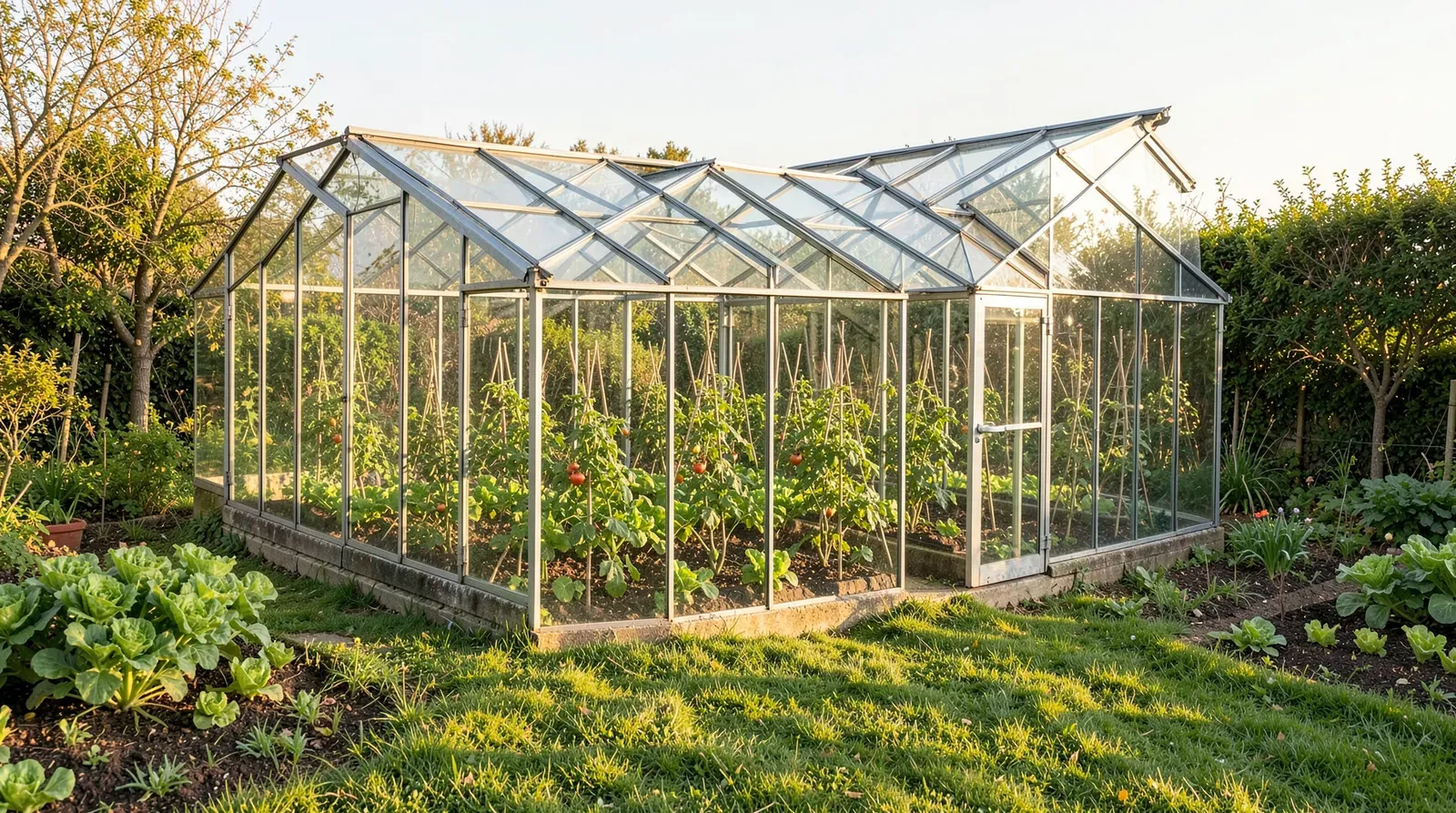
Claire lost her tomatoes on an October Tuesday. Frost settled on her garden in Angers overnight. By morning, her plants laden with green fruit had blackened — three months of patience wiped out in a single evening. In February, she ordered a greenhouse. The following March, her radishes were coming up while her neighbor was still waiting for April.
This page exists so you never have to tell the same story. A garden greenhouse is a growing shelter with transparent walls that captures the sun’s heat: your seedlings get off to an earlier start in spring, your tomatoes keep ripening for several extra weeks in fall, and your delicate plants spend the winter safe from frost and wind. Choosing the right one comes down to three decisions — first the intended use (seed starting, summer tomatoes, overwintering, or year-round production), then the type of covering (polytunnel, polycarbonate, or glass), and finally the size, with a range of 10 to 20 m² that covers most family uses. As for budget, the 2026 price surveys from specialist guides run from €100 for an entry-level polytunnel to more than €5,000 for a large tempered-glass greenhouse (conseils-maison.fr, habitatio.fr). And the paperwork? Below 1.80 m in height, no formalities at all outside protected areas, according to the official Service-Public page devoted to greenhouses and cold frames. That’s the essentials. The rest of this guide turns those three decisions into an action plan — figure by figure, step by step.
Transparency about sources. For anything touching on regulations, this guide cites official texts first. The practical figures (sizes, prices, yields) come from recent editorial and commercial guides, and are flagged as such. We found no INRAE, ADEME, or INSEE study devoted to home garden greenhouses — rather than put forward an unverifiable figure, we’d rather say so.
Contents
- What is a garden greenhouse?
- Choosing your greenhouse: the criteria that make the difference
- Installing the greenhouse: location, soil, and assembly
- What to grow? The complete calendar
- Maximizing yield: hydroponics and vertical growing
- Budget and payback
- FAQ
- Conclusion
What is a garden greenhouse? The principle and the types to know
The principle: capturing light, holding heat
Picture a Saturday morning in March. Your neighbors are still hesitating in front of their waterlogged vegetable patch; you, you’re already sowing. Two weeks later, your radishes are up while their seeds are still asleep in their packets. A garden greenhouse gives you that head start every year. But you still need to understand what it really does — and what it doesn’t. That alone prevents half the disappointments at purchase.
The mechanism takes two sentences. The walls let in sunlight, which warms the air and the soil; the heated surfaces then re-emit heat that those same walls partially hold in — and that is the whole greenhouse effect. Three levers work at the same time: temperature, with heat stored during the day and partly released at night; humidity, which climbs fast in an enclosed volume; and protection from wind, rain, and hail (monjardinmonpotager.fr, habitats-durables.org).
The promise is real: an earlier start in spring, and harvest density that no open-air plot of the same size can match. But there is a catch, and you’re better off knowing it before pulling out your credit card. An unheated greenhouse does not guarantee frost-free conditions in the depths of winter.
No miracles in January. The greenhouse effect is often enough to keep hardy crops active — nothing more (habitatio.fr). And at the other end of the season, the same enclosed volume can become hotter than it is outside, enough to stress your plants. So choose ventilation and shading along with the greenhouse, not after the first heat wave.
Three cousins round out the range: the plastic polytunnel, more seasonal; the cold frame, king of small spaces; the mini greenhouse, sized for seed starting and balconies. All that’s left is to pick your model from the five main families on the French market. This is the first decision — and the easiest of all to get wrong.
The five main greenhouse families
Each family matches a gardener profile, and yours is on the list. The French market splits into five types, which balance sturdiness, insulation, budget, and working comfort in different ways (habitatio.fr, habitats-durables.org).
| Type | Best suited for | Main strengths | Points to watch |
|---|---|---|---|
| Plastic film polytunnel | Seasonal crops, tomatoes, first equipment | Large area on a tight budget; can be assembled and taken down | Cover lifespan, anchoring, wind resistance, ventilation |
| Multiwall polycarbonate | Seed starting, overwintering, regular use | Lightweight, impact-resistant, good insulation, diffused light | Light transmission, panel thickness and warranty, condensation |
| Glass | Permanent installation, citrus, botanical growing | Excellent light, long lifespan, easy cleaning | Safety glass in exposed areas, weight, foundation, breakage |
| Lean-to greenhouse | Small plots, access from the house | One wall fewer, everyday comfort | Shade from the building, overheating, connections and water drainage |
| Mini greenhouse / cold frame | Seed starting, cuttings, balconies | Minimal footprint, low trial price | Wide temperature swings, limited volume for mature plants |
Table compiled from habitatio.fr and habitats-durables.org.
A few pointers for reading this table — each row hides a decision. The polytunnel rests on galvanized steel hoops under a UV-treated polyethylene film; it suits in-ground growing, summer vegetables, and early sowings, but the cover ages and gets replaced, and anchoring must be taken seriously. Multiwall polycarbonate bets on rigid panels with air channels: those cells insulate, and the diffused light spares the foliage from scorching. Glass remains the benchmark for light and lifespan — the choice of lovers of container citrus and orangery plants, at the cost of a foundation worthy of the name. The lean-to greenhouse shares a wall with the house, perfect on a narrow plot as long as the building’s cast shadow stays manageable. Mini greenhouses and cold frames, finally, cover seed starting, cuttings, and balconies without a heavy financial commitment.
Five families, then. But the right question isn’t “which greenhouse?” — it’s “what for?”.
The right greenhouse for each project
Every source converges on this point: the choice starts from the growing project, not the displayed price. Seed starting, summer tomatoes, overwintering, and heated growing do not call for the same equipment at all (habitatio.fr).
So, who are you?
Just starting out and not looking for a heavy commitment? A mini greenhouse, a cold frame, or a small polytunnel is enough to learn, at a reduced budget and footprint. Feeding a family from a seasonal vegetable garden, with tomatoes and zucchini leading the list? The polytunnel offers the best area-to-price ratio (conseils-maison.fr).
Growing every weekend, all year round? Polycarbonate dominates: the 2026 guides rank it first for mixed use, and it’s the field we know best in soilless growing. Dreaming of citrus in pots and orangery plants? The extra cost of glass is justified — and paid only once. Is your plot narrow, along the side of the house? The lean-to does the job, as long as the building’s shade stays under control.
Votre projet ?
│
├─ Premier essai / petit budget ─────► Mini-serre ou tunnel (dès 100 €)
├─ Tomates d'été, potager saisonnier ─► Tunnel 5-20 m² (100-500 €)
├─ Culture régulière toute l'année ───► Polycarbonate (600-2 000 €)
├─ Agrumes, botanique, durable ───────► Verre (2 000-8 000 €)
└─ Terrain étroit contre un mur ──────► Serre adossée (prix variable)
Is your project in the tree? One criterion remains to settle, the one that makes or breaks everything else: the size. And here, sellers tell a little story you need to know before paying.
Choosing a garden greenhouse: the criteria that make the difference
Size: draw it out before you pay
The guides put forward 4 to 20 m² for family use (a-vos-projets.fr, lesplanchesendessin.fr). Below that, 5 to 10 m² does the job for seed starting and overwintering a few pots. Above it, 10 to 20 m² accommodates a good range of vegetables, comfortable circulation, even a work table and some shelving.
The “one-tenth rule” — 10 m² of greenhouse per 100 m² of vegetable garden — circulates among sellers (lesserresdejardin.com). Handy for selling, no doubt.
No one validates it. No public body vouches for it, and to say it deserves to be taken with a grain of salt would be an understatement. The reliable method comes down to a scale drawing: measure your plants at adult size, place beds and tables, reserve an aisle wide enough for a wheelbarrow, check the swing of doors and vents (habitatio.fr).
As for height, the criterion that commands consensus boils down to three words: work standing up. A specialist market-gardening guide recommends 1.80 to 2 m at gutter height and about 2.5 m at the ridge for family use, the ridge height also improving air circulation as a bonus (lateleagricole.net).
Quick method. List your five main crops, note their adult footprint, add a 60 to 80 cm aisle and a seed-starting area. If the plan fits in 10 m², there’s no point paying for bigger.
Size settled? On to the skeleton and the skin of your greenhouse — the frame, then the covering. That matchup decides its lifespan.
Frame and covering: the materials showdown
For the frame, aluminum does not rust, requires no paint, and assembles with connectors, no welding; it is also the most expensive item in the kit (readscheme.org). Galvanized steel equips most polytunnels, with a good strength-to-price ratio.
One point deserves your attention before any payment. Picture your polytunnel on a stormy Sunday: wind rushes under the cover, the hoops bend, the frame follows. The guides say it bluntly: entry-level structures that are too light “withstand neither wind nor snow” (jardinbeauregard.com). On an exposed site, a reinforced frame always costs less than a greenhouse flattened by a storm.
The wind, for its part, hasn’t read your warranty.
Three covering families share the market. The polyethylene film of polytunnels costs little and includes a UV treatment, but it is replaced periodically and must be kept taut. Multiwall polycarbonate suffers from an undeserved reputation: contrary to the received idea, double- or triple-wall panels insulate better than single glass and diffuse a soft light (jardinbeauregard.com). Check the thickness, the warranty, and the fixing method — and mount the UV-treated face facing outward, otherwise the panel yellows prematurely; the cell channels must stay open at the bottom to vent condensation. Tempered glass, finally: the highest light transmission, simple cleaning, superior longevity — at the price of a foundation, a frame that carries its weight and, in walk-through areas, safety glass (habitatio.fr).
Frame and covering chosen, the bill remains. It is almost always longer than the displayed price — here’s why.
The full budget: the kit price is only the beginning
Your ambition sets the budget, not the other way around. A trial or a first setup: €100 to €500 for a 5 to 20 m² polytunnel or a mini greenhouse. A regular family vegetable garden calls rather for polycarbonate, between €600 and €2,000 — about €600 for a 5.7 m² model, according to the surveys by conseils-maison.fr. A permanent tempered-glass installation starts around €2,000 and easily crosses €8,000 for a large structure.
The 2026 reviews share the same warning: the kit price does not make the budget. Anchoring, base, extra vents, shading, irrigation, delivery, replacement parts (habitatio.fr) — it all adds up.
Line by line.
The most solid buying method? Ask for three quotes or carts with an identical scope — delivery, base, anchoring, number of vents, assembly, warranties — before any comparison. Without that framing, you’re comparing apples and oranges.
Five families, six criteria, three price ranges: everything boils down to a single table. Here it is.
The table that sums it all up
| Criterion | Polytunnel | Polycarbonate | Glass | Lean-to | Mini greenhouse |
|---|---|---|---|---|---|
| Observed budget | €100-500 | €400-2,000 | €2,000-8,000 | Varies | Very low |
| Insulation | Low | Good (multiwall) | Medium | Good (shared wall) | Low |
| Light | Good | Diffused | Excellent | Good | Fair |
| Lifespan | Low to medium | Medium to good | High | High | Low |
| Ideal profile | Beginner, seasonal | Regular, family | Enthusiast, long-term | Small plot | Seed starting, balcony |
Qualitative synthesis based on habitatio.fr, habitats-durables.org and conseils-maison.fr. The budgets are observed examples, not market averages.
The table has picked your greenhouse. It won’t produce anything good sitting in the wrong spot, on the wrong soil — and that is precisely where most buyers go wrong.
Installing the greenhouse: location, soil, and assembly
Location and orientation: the 3 criteria that command consensus
The best greenhouse in the world, planted behind a shed, in the shade of a tree and a hundred meters from the tap, will produce less than an average greenhouse set twenty steps from your door. Location is not decided at the end of a stroll through the garden: it is settled before ordering.
Three criteria command consensus: sun, access to water, shelter from wind (conseils-travaux.com). Add a draining soil, convenient access, and a question that decides everything: is the greenhouse close enough to the house to be watered and checked regularly? A greenhouse you don’t see is a greenhouse you forget (habitatio.fr). An agricultural guide adds two concrete thresholds: at least 10 m of clear space around, and protection of the prevailing wind by a hedge, a low wall or a natural windbreak (lateleagricole.net).
Orientation: a genuine disagreement between sources. habitats-durables.org recommends the east-west axis for year-round use (more even light), and north-south in cold regions to capture the low winter sun. lateleagricole.net recommends exactly the opposite. The gap probably stems from different conventions — ridge axis or long façade — but neither source bothers to spell it out. Rather than settle it arbitrarily, watch the sun’s course at your place, season by season: winter capture to produce early, summer evenness for heat-loving crops.
Location chosen. All that remains is the ground itself — and that is where the geometry of the whole structure is won or lost.
Soil, drainage, and foundations
Site preparation determines the final geometry. According to habitats-durables.org: “Marking out, stripping the topsoil, leveling and checking the diagonals determine the geometry of the greenhouse. Poor shimming shows up instantly in the assembly.” In other words: approximate shimming on the ground, and the whole assembly remembers it.
Weed the area before the kit arrives, by hand or by occultation under black sheeting to weaken the perennials. Then check that water drains away without stagnating (habitatio.fr); on soil that holds moisture, an application of gravel or a slight raising of the base saves a lot of trouble. The foundation or base follows the manufacturer’s manual, with anchors sized for the wind on your site.
Ground ready, kit ordered. All that’s left is to assemble it — in the right order, or not at all.
Assembly in 7 steps
- Unpack and check every box on receipt: gables, base and accessories sometimes travel separately.
- Mark out the position on the ground and check the diagonals before any permanent fixing.
- Lay the foundation or base, anchoring included.
- Assemble the frame as a pair, checking the geometry before the final tightening.
- Fit the covering, then doors and vents, following the manual.
- Test the ventilation: open, observe, adjust.
- Connect gutters and a water tank, install shading, lay out the interior — tables, aisles, beds.
A detail about water: rainwater harvesting follows the rules of the decree of August 21, 2008, and drought-period restrictions are posted on vigieau.gouv.fr. Also think ahead about logistics from the moment you order: “no truck access” and “very long, fragile parcels” rank among the costliest oversights (habitatio.fr). And check before buying the availability of spare parts — cover, seals, clips. Without them, a single broken pane can doom an entire greenhouse.
Seven steps followed to the letter, and your greenhouse will last for years. Skip a single one, and here’s the bill.
The 6 costly mistakes
Choosing too small, first. You forget the aisle, the tables, the adult size of the plants — and the greenhouse quickly becomes a compact storeroom where you bang into something on every visit.
Neglecting ventilation and shading, next. More insidious: a greenhouse can exceed outdoor temperatures, and this equipment is negotiated at purchase, not during the heat wave (habitatio.fr). A detail that counts: a roof vent releases the hot air built up under the ridge far better than a single door left open at the front.
Then comes the false economy. Entry-level structures that are too light resist wind and snow poorly (jardinbeauregard.com), and improvised anchoring is paid for in a deformed assembly (habitats-durables.org). How many polytunnels took flight in the recent storms for lack of four serious anchor points? Hard to say — but no one has ever regretted anchoring too solidly.
Finally, add two administrative and logistical oversights: ignoring the local development plan (PLU) and the development tax before buying (we come back to this in the FAQ), and choosing a brand whose spare parts you can’t find anywhere. In both cases, the bill arrives later — and bigger.
A well-sited greenhouse is half the work. The other half begins the day you sow — and it follows a precise calendar.
What to grow in a greenhouse? The complete calendar
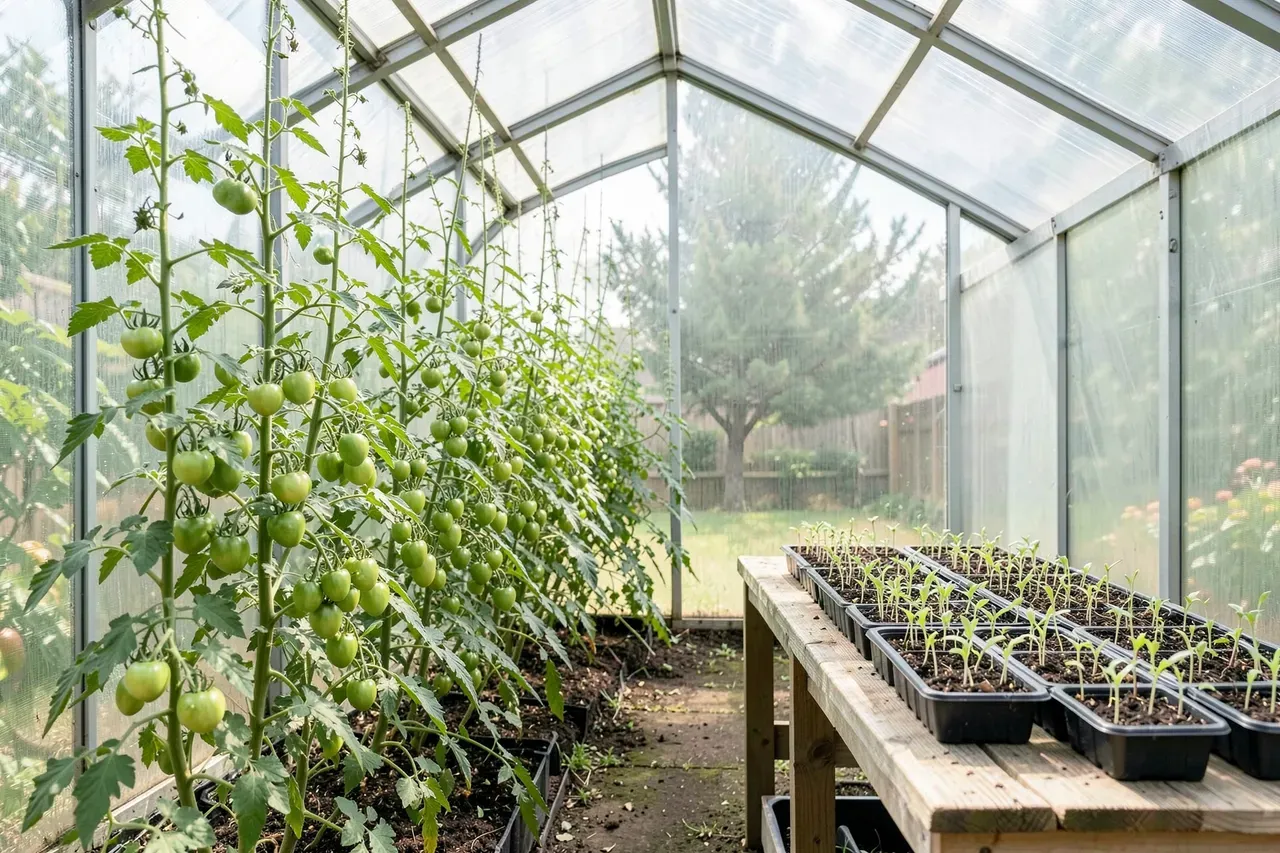
The crops that benefit most from the shelter
Picture your tomato plants in July. Outdoors, a hailstorm can wipe out in ten minutes what you sowed in March. Behind the transparent panel, the rain stays outside, the wind goes around, and the fruit keeps growing. There, in one scene, is why some crops gain so much from being sheltered.
The guides agree on a short list: tomatoes, cucumbers, peppers and eggplants among warm-climate vegetables; lettuce, radishes, spinach and early carrots among early sowings; strawberries, zucchini, beans and herbs complete the picture (habitats-durables.org). Their yield rests on three levers: the accumulated heat, the protection from hazards, and vertical growing — staked tomatoes and cucumbers free up the ground for lettuce and radishes.
One atmospheric nuance to keep in mind: the tomato prefers dry when the cucumber demands humidity. In a small volume, this coexistence is managed through ventilation.
And a promise that no one can keep for you: no institutional data quantifies the yield of a hobby greenhouse. Real productivity will depend on your climate, your water and the time you devote to it. No one can promise you that.
These crops do not all have their place at the same time. Twelve months, six periods: here is the calendar.
The month-by-month calendar
| Period | Main use | Crops and tasks cited by the sources |
|---|---|---|
| January–February | Overwintering, very early sowings | Protected potted plants; first lettuce under cover |
| March–April | Sowing under cover | Tomatoes, peppers, eggplants; lettuce, radishes, spinach, early carrots |
| May–June | Planting, early crops | Transplanting, lettuce, first radishes |
| June–August | Warm-climate vegetables | Tomatoes, cucumbers, peppers/chilies, eggplants, zucchini |
| September–October | Fall sowings | Winter lettuce, spinach, overwintering preparation |
| November–December | Hardy crops and protection | Lamb’s lettuce, spinach, baby leeks, storage carrots |
Generic calendar built from habitats-durables.org and habitatio.fr. No regionalized institutional reference was identified: shift these windows by several weeks depending on your region.
Harvesting all twelve months: the three levels of ambition
Harvesting all year round comes down to one discipline: chaining uses through the seasons instead of planting everything in May. Late-winter early sowings, summer vegetables, winter hardies take turns in the same volume. For winter, three levels of ambition take shape — yours to choose.
The cold greenhouse, unheated, advances the crops and protects them according to hardiness, with no frost-free guarantee (habitatio.fr). The cool greenhouse maintains 3 to 8 °C thanks to a small backup heater triggered during cold snaps (habitats-durables.org). Passive solutions, finally, extend the heat stored during the day: the inertia of a stone wall, water cans painted black, night covering of the tender crops.
⚠ Safety: if you heat, reduce the volume to be heated first, and ban any improvised combustion appliance from this space (habitatio.fr).
Protecting the season is good. Almost doing away with it is better — and that comes down to two techniques whose sales pitches announce spectacular figures.
Maximizing yield: hydroponics and vertical growing
Greenhouse hydroponics: what the announced figures are worth
Soilless growing removes the soil from the equation: the roots bathe in a solution of water and nutrients, recycled in a closed loop and oxygenated continuously. Combined with a greenhouse, hydroponics brings two effects together — the climate protection of the shelter on one side, the fine control of water and nutrition on the other. Production cycles follow one another almost without interruption. Something no in-ground growing offers at the same pace.
The manufacturers announce yield gains of 3 to 10 depending on the crops and the density of the installation. What are these figures worth? Commercial benchmarks, not validated by an independent study in our research — we prefer to say so frankly. Presenting them as demonstrated would be lying to you. And you would feel it.
What does check out are the qualitative levers: vertical stacking of production, water recycled in a closed loop, nutrient dosing monitored by probe (electrical conductivity and pH are checked regularly), a stretched season. Two constraints to accept before you start: dependence on electricity for the pump and aeration, and regular monitoring of the solution. A hydroponic system left on its own does not forgive forgetfulness.
Hydroponics changes the controls. Vertical growing changes the geometry — and makes every square meter count twice.
Vertical towers: every square meter counts double
Vertical towers grow at height what you usually plant in the ground: lettuce, strawberries, herbs, baby greens. The principle fits in one sentence — several tiers of growing pockets on a single square meter of floor, fed continuously. They excel at short-cycle leafy vegetables, precisely the ones that make the best use of a reduced volume. Two limits to factor in from the planning stage: stability — a tower full of water and substrate weighs heavy — and the evenness of light between tiers, which the diffusion of polycarbonate does much to smooth out.
Protected, controlled, stacked: a hydroponic installation often displays a quantified production target. Here is one that circulates widely — and deserves to be put through the wringer.
22 m² for 500 kg of vegetables a year: does the math hold up?
This figure circulates as a production target in the sales pitches of intensive hydroponic greenhouses: 22 m² for 500 kg of vegetables per year. Let’s put it through the wringer. 500 kg ÷ 22 m² ≈ 23 kg/m²/year, or nearly 1.9 kg per square meter per month, all crops combined. A demanding target, but consistent for a well-run intensive system — and no comparison with professional greenhouses, which benefit from permanent climate and nutrient control.
Rather than buy a ready-made ratio, build your own. List what your household actually buys: lettuce every week, tomatoes from June to October, strawberries in spring, herbs all year. Estimate the weekly quantities — the greenhouse now covers the months when you used to buy — and add up over twelve months. The total gives your realistic target, to be compared with the example’s 500 kg.
No public body (INRAE, ADEME, INSEE) publishes a yield for domestic garden greenhouses; we prefer to give you the method rather than an unverifiable figure. To see what a complete system sized on this principle delivers, explore our 22 m² hydroponic greenhouse.
Method, materials, calendar, techniques: one question remains, the one you have been asking since the first line. How much does it cost — and how much does it bring back.
Budget and payback of a garden greenhouse
Prices by range: how much to pay, for what?
| Range | Type | Observed budget | Source |
|---|---|---|---|
| Entry level | Polytunnel 5-20 m² | €100 to €500 | conseils-maison.fr |
| Mid-range | Polycarbonate 5-15 m² | €400 to €2,000 (about €600 for 5.7 m²) | conseils-maison.fr |
| Upper mid-range | Rigid polycarbonate kit | Often > €1,000 | habitatio.fr |
| Premium | Family tempered glass | €2,000 to €5,000, up to €7,000-8,000 for a large structure | conseils-maison.fr |
Observed catalog examples, not market averages (habitatio.fr). Add to the budget the anchoring, the base, the vents, the shading, the irrigation, the delivery — and the development tax if your declared greenhouse exceeds 5 m².
The prices, you have them. The savings, now — and they are not calculated in the sellers’ catalogs, but in your checkout receipts.
Annual savings: start from your checkout receipts
No “standard annual saving” is calculated once and for all, and that is the honesty point to own: everything depends on the crops, the climate, the available time, the water and the purchases actually avoided (habitatio.fr). The method that works starts from your own shopping, not a theoretical average.
An illustrative example, therefore fictional: a family that buys €20 of lettuce, tomatoes and herbs every week from March to November avoids €20 × 40 weeks = €800 a year.
€800. A year.
Your own shopping list, detailed crop by crop, will give your own figure. It is that — and not an average — that should guide the decision.
With the annual saving in hand, the payback becomes a simple division. But two caveats separate honest math from sales math.
Payback, in two lines and two caveats
The formula fits in one line: total cost ÷ annual saving = payback period. With the example above: €1,600 ÷ €800/year = 2 years.
Two summers.
First caveat, durability: “a cheap greenhouse can cost a lot in repairs — invest in robust materials from the start; it is often more cost-effective over ten years” (lesserresdejardin.com). Second caveat, the professional orders of magnitude: an agricultural guide puts the payback of the equipment at 10 to 15 years and maintenance at about 5% a year for a galvanized steel greenhouse — benchmarks drawn from field feedback, not statistically validated (lateleagricole.net). For the home gardener you are, the honest calculation remains the total cost of ownership, line item by line item; a theoretical ROI will never pay for a replacement cover.
These calculations always raise the same questions. Here they are — with direct, sourced answers.
FAQ — Your questions about the garden greenhouse
How much space do you need?
For versatile family use, 10 to 20 m² fits in most cases; 5 to 10 m² is enough for seed starting and overwintering a few plants. The consensus of the guides sits around 10 m², but the only reliable test remains the drawing: crops at adult size, aisle, tables (habitatio.fr).
Do you need a building permit?
In general, no for low greenhouses. According to the official Service-Public page dedicated to greenhouses and cold frames (checked April 2026, reported by habitatio.fr): exemption from formalities up to 1.80 m in height outside protected areas, and for any temporary installation of less than three months (fifteen days in protected areas). Between 1.80 and 4 m and up to 2,000 m²: prior declaration. Beyond 4 m or 2,000 m²: building permit. The generic 5 and 20 m² thresholds of the French planning code also apply depending on the zone (Légifrance), and the local development plan (PLU) may add local rules. If in doubt, a visit to the town hall settles it — also consider the official development tax simulator.
Can you use it in winter?
Yes, with nuances. An unheated greenhouse protects hardy plants and advances the seedlings, but does not guarantee frost-free conditions; a cool greenhouse maintains 3-8 °C with a small electric backup (habitats-durables.org). The passive solutions — water cans painted black, night covering, the inertia of a stone wall — extend the heat stored during the day. And you will never heat it with an improvised combustion appliance.
How many kilos of vegetables per year?
No reliable figure circulates. No public body (INRAE, ADEME, INSEE) publishes a yield for domestic garden greenhouses, and the online estimates come from commercial sources. The drivers are qualitative: a size suited to the use, thermal management, ventilation, watering. For your case, list your replaceable purchases and build your own target — the method detailed above builds on the 22 m² / 500 kg scenario.
What maintenance should you plan for?
The annual backbone comes down to three tasks: cleaning the panels inside and out, with warm water and black soap preferably in late winter (habitats-durables.org), checking the fixings, seals and hinges, and immediately replacing any damaged part — a small hole in a cover quickly becomes a tear in the wind. Day to day: ventilate to limit condensation, water according to the crop and the weather (no fixed amount per m²) and track the temperatures with a min-max thermometer (habitatio.fr).
With these answers in hand, only one thing remains to do: decide. Here is the essential to remember — and the decision that changes everything.
Conclusion — Step up to production with a garden greenhouse
Key takeaways
What to remember? The intended use sizes the greenhouse, never a standard ratio: seed starting, summer tomatoes, overwintering or year-round production call for different equipment.
On materials, polycarbonate offers the most solid balance for regular use — the 2026 guides rank it first for mixed use — the polytunnel does the job when you’re starting out, glass lasts. The full budget ranges from €100-500 for a polytunnel to €600-2,000 in polycarbonate and €2,000-8,000 in glass, excluding anchoring, shading and irrigation.
On formalities, the exemption below 1.80 m outside protected areas simplifies life for the majority of projects (service-public.fr); beyond that, a prior declaration and a visit to the town hall are generally enough. And on winter, stay clear-eyed: the cold greenhouse advances and protects, without promising frost-free conditions.
Why the 22 m² hydroponic greenhouse changes the game
A conventional greenhouse extends the season; a hydroponic greenhouse all but removes it. By combining the climate shelter and recycled soilless growing, it turns 22 m² of floor into a continuous production system: lettuce and herbs in vertical towers, warm-season vegetables in season, water reused in a closed loop. Ready to move from trial gardening to serious production? Discover our 22 m² hydroponic greenhouse, along with our companion guides: mini greenhouses and cold frames to get started and using your greenhouse in winter.
In ten minutes, you will know whether your seedlings will start a month earlier and your tomatoes will still be ripening in November — or whether the first frost will keep deciding for you. Measure your vegetable patch, list your five crops, compare three quotes. Next fall, what’s on your table won’t be green tomatoes blackened by a frosty night. They’ll be your own.
Main sources
Official and institutional sources:
- service-public.fr — File “Building permits and other planning authorizations”; page dedicated to garden greenhouses and cold frames (rules by height, surface and duration, reported and verified by habitatio.fr in April 2026).
- legifrance.gouv.fr — French Planning Code (articles R. 421-2 and R. 421-9); decree of August 21, 2008 on rainwater harvesting.
- vigieau.gouv.fr — Water restrictions applicable to watering during drought periods.
Editorial and commercial sources (prices and usage benchmarks, indicative):
- habitatio.fr — “Garden greenhouse 2026”; cost items, types, formalities, taxes, absence of a national tax credit.
- conseils-maison.fr — 2026 prices and regulations.
- habitats-durables.org — Typology, growing calendar, cool greenhouse 3-8 °C, maintenance.
- lateleagricole.net — Areas and heights by profile, professional payback.
- lesserresdejardin.com, jardinbeauregard.com, lesplanchesendessin.fr, a-vos-projets.fr, readscheme.org, conseils-travaux.com, monjardinmonpotager.fr.
Acknowledged limitations: no INRAE/ADEME/INSEE study specific to domestic garden greenhouses was identified; the yields in kg/year, the announced hydroponic gains and the “one-tenth of the vegetable garden” ratio are not validated by any institutional source and are flagged as such.
SEO elements (for CMS integration) — Title tag: Garden greenhouse: complete 2026 guide (choice, prices, installation) — Meta description: Garden greenhouse: types, 2026 prices, permits, step-by-step assembly and growing calendar. The complete guide to choosing, installing and growing all year round. — Image alts: “Polycarbonate garden greenhouse installed in a family vegetable garden”; “Greenhouse growing: staked tomatoes and a seedling table”.
Ready to Grow Your Own Vegetables All Year Round?
Discover our soil-less growing solutions, aeroponic greenhouse or indoor hydroponic cabinet, and take the path to food self-sufficiency without pesticides.