
permaculture-vegetable-garden
Permaculture Vegetable Garden: Design a Productive, Sustainable and Self-Sufficient Garden
Design a permaculture vegetable garden that feeds you year-round: zoning, companion planting, rotation, calendar, greenhouse and budget, with real figures.
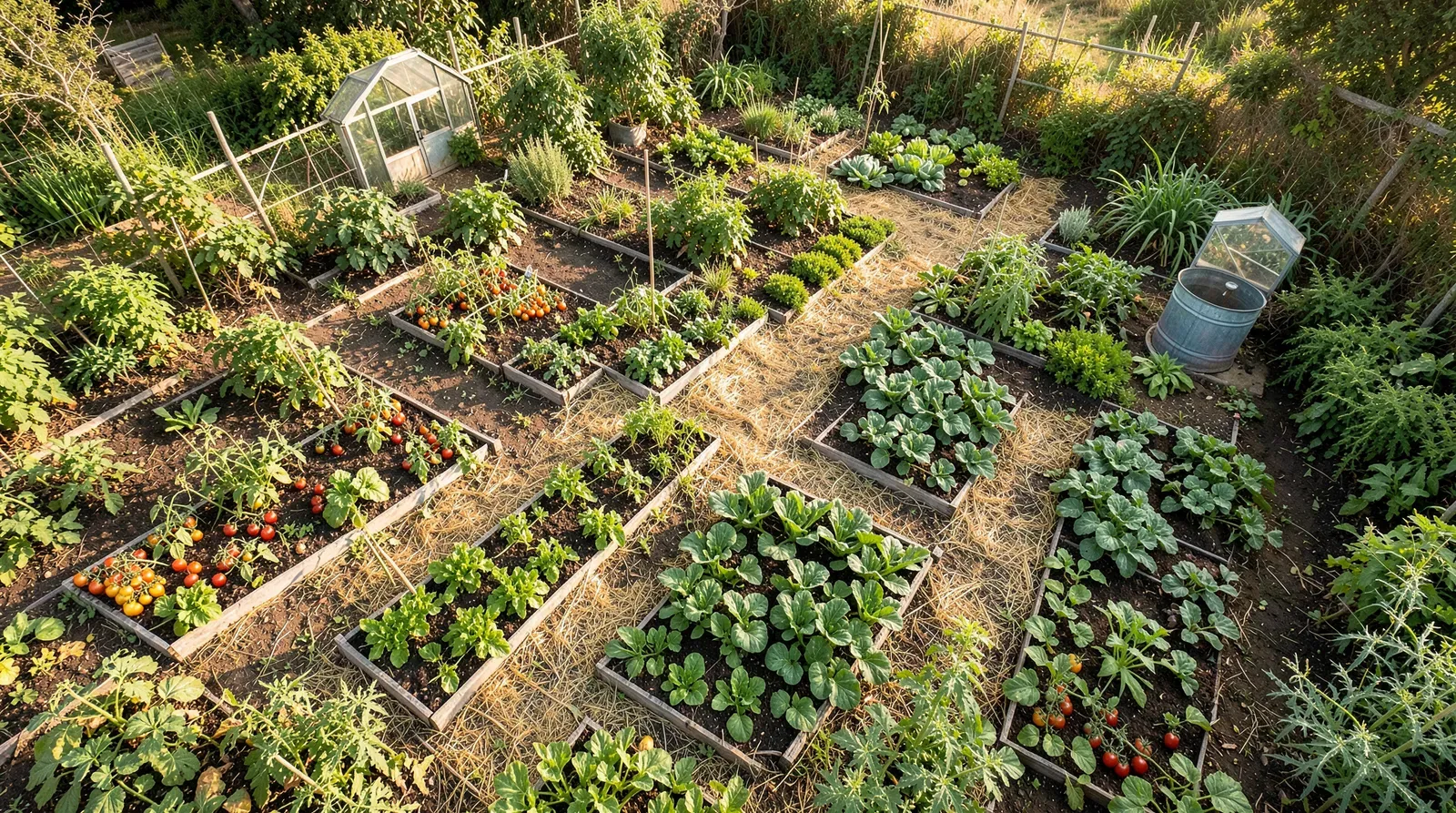
Marc spent an entire Saturday digging his vegetable garden. Southern Lyon area, April, 40 m² of good soil. Straight rows marked out with string, tomato plants lined up, plenty of hope. By July: tomatoes languishing in the shade, water pooling in the wrong place, leaves scorched by the wind.
His problem wasn’t a lack of sweat. It was the absence of a plan.
A permaculture vegetable garden is run like an ecosystem: instead of correcting nature, you copy its operating manual, and the garden ends up yielding more vegetables for less water, fewer hours of digging and zero chemicals. There’s nothing mystical about it, and it can be measured. Between 2011 and 2015, INRA and AgroParisTech — Kevin Morel, Sarah Guégan and François Léger — studied the Bec Hellouin farm in Normandy. Their conclusion: 1,000 m² of intensive permaculture market gardening is enough to generate an income equivalent to the French minimum wage (SMIC), with about 43 hours of work per week.
Forty-three hours a week, though.
This guide walks you through the whole process, from the starting principle to the payback calculation: site assessment, plan, companion planting, crop rotation, calendar, greenhouse, budget. And Marc’s story, rest assured, ends well — because it resembles that of anyone who corrects course before the following season.
Key figure: a 2024 study published by RPTU Kaiserslautern-Landau University (Germany) and BOKU University in Vienna (Austria) shows that permaculture plots outperform conventional organic farming in biodiversity, soil quality and carbon storage, with a land equivalence ratio (LER) of 1.44 — i.e., 44% higher productivity per unit of cultivated land.
Table of contents
- The basics of the permaculture vegetable garden
- Designing your permaculture vegetable garden: step-by-step design
- The production calendar
- Integrating a greenhouse into your vegetable garden
- Budget and profitability of a permaculture vegetable garden
- FAQ — Your questions about the permaculture vegetable garden
- Move to production
The basics of the permaculture vegetable garden
Permaculture, a contraction of Permanent Agriculture, was born in 1970s Australia, from the pens of Bill Mollison and David Holmgren. Their definition fits in one sentence: “an ethical design approach aimed at building sustainable human habitats by imitating the way nature works”. Two words matter there — design as much as ethics. Before you plant, you draw up a system.
In the vegetable garden, the difference quickly becomes obvious: no more isolated rows lined up with string — Marc’s rows, exactly — and instead a living whole in which every element serves the others. Popularized in France by Charles and Perrine Hervé-Gruyer at the Bec Hellouin farm, the approach has in fifteen years become the benchmark for the sustainable organic garden — to the point where it’s sometimes cited everywhere, rightly or wrongly, but the underlying idea holds up.
But what does imitating nature actually mean in practice? It all starts with three ethical principles… and a scientific foundation that is too often forgotten.
A three-part ethics, grounded in science
Mollison and Holmgren laid down three ethical principles. Care for the Earth: regenerate soils instead of depleting them, protect biodiversity, respect natural cycles — every gesture in the garden is meant to feed the ecosystem rather than nibble away at it. Care for People: produce healthy, abundant food, create a pleasant living space, gain food self-sufficiency. Fair share, finally: redistribute surpluses, exchange seeds and know-how, curb overconsumption.
Three simple sentences. Years to apply them.
Behind this ethics lies serious science. Specialized sources link it to the work of Francis Hallé on forest ecosystems, Marc-André Selosse on microbial symbioses, and Lydia and Claude Bourguignon on soil biology. Some authors also cite the ecologist Robert Harding Whittaker, according to whom a mature natural ecosystem would produce twice as much biomass as conventionally farmed land: 1,200 g/m²/year versus 650 g/m²/year.
A word of caution, however — because you deserve facts, not legends. This figure circulates in the specialized press, but it would benefit from being verified in primary publications before being trotted out at dinner parties; it nevertheless gives the order of magnitude of the potential of a garden that imitates natural systems.
And that potential, precisely, slips away from most gardeners for one specific reason. Not the soil. Not the climate. The order of operations.
Observe before planting: the 4 parameters that decide everything
Here is the classic beginner’s mistake: dig, plant, water… then discover in July that the tomatoes are languishing in the shade, that water pools in the wrong place and that the wind has scorched everything else. Marc’s scenario, word for word. Most failed vegetable gardens fail for lack of observation, not lack of sweat.
Permaculture reverses the logic. You look first, you act second. The trade maxim sums it up: “one year of observation is worth ten years of corrections” — exaggerated, no doubt, but not by much. Some guides soften the prescription to 4–12 weeks and estimate that this phase determines “80% of the success of the vegetable garden”; a practitioner’s estimate, not measured data, but the stakes are real.
Your assessment covers four parameters.
Sunlight. Map the areas that receive at least 6 hours of direct sun, the threshold for demanding crops (tomatoes, zucchini, peppers). Record the shade in winter AND in summer: the sun never takes the same path twice.
Hydrology. Mark the low spots where water pools after rain, then the areas that dry out in less than 48 hours. You have just drawn your future irrigation map.
For free.
Wind. Note the direction of the prevailing winds. Practitioners estimate that a 30 km/h wind lowers the temperature felt by plants by 3 to 5 °C — an indicative order of magnitude, but enough to justify a well-placed windbreak.
Soil. The “jar test” remains the simplest: soil + water, shaken, 24 hours of settling. The layers that settle out (clay, silt, sand) tell the story of your soil’s texture.
Add a formidable biological thermometer: earthworm counting. Push in a spade, lift a clod, count. According to the Participatory Earthworm Observatory (OPVT), a citizen-science program, healthy soil hosts about 250 worms per m²; below 50, the soil is degraded and calls for massive inputs of organic matter before any planting.
Then there’s water — and this may be where your land holds the best surprise. France receives on average about 770 mm of rain per year (national climate averages). The math is quick: a 50 m² tiled roof, runoff coefficient 0.9, captures about 770 × 50 × 0.9 ≈ 34,650 liters per year.
Read that figure again. Slowly.
Enough to water a 30 m² vegetable garden all through the warm season, whereas a 1,000-liter rain barrel runs dry after two to three weeks of dry summer weather.
Two to three weeks.
The difference comes down to one word: storage. You can record these four parameters in a single weekend. But observation alone doesn’t grow a zucchini — it needs a decision-making framework. David Holmgren formalized twelve of them.
Holmgren’s twelve principles, garden side
David Holmgren formalized twelve design principles, genuine working tools: observe and interact; catch and store energy; obtain a yield; apply self-regulation and accept feedback; use and value renewable resources and services; produce no waste; design from patterns to details; integrate rather than segregate; use small and slow solutions; use and value diversity; use edges and value the marginal; creatively use and respond to change.
Four of them directly structure a vegetable garden. Observe and interact: relearn how to look at which plants grow on their own, which insects already live on site, where the noon sun strikes — before any rash intervention. Use and value diversity: it is what gives the system its resilience in the face of hazards, through companion plantings where each plant serves its neighbors (nitrogen fixation, pest repellence, attraction of beneficial insects). Each element performs multiple functions: a shrub can be at once a windbreak, a refuge for beneficial insects and a fruit producer, and the more roles an element accumulates, the better the system performs on a small area. The problem is the solution, finally: if an imbalance appears, a connection between two elements is probably missing. Aphids show up en masse? The ladybugs that eat them are missing in action.
The institutional parallel: the NRCS, the natural resources conservation service of the US Department of Agriculture (USDA), promotes four principles of soil health: keep the soil covered, maintain living roots as long as possible, diversify plants, limit mechanical disturbance. The convergence with permaculture (permanent mulching, green manures, polyculture, no-till) is total.
When a department of agriculture and permaculture market gardeners reach the same conclusions by different routes, you have a strong signal. All that remains is to turn these principles into a plan. And it starts with a siting rule of disarming simplicity.
Designing your permaculture vegetable garden: step-by-step design
Time for the pencil. Designing means answering three questions, in this order: where to put what (zoning), what to plant next to what (companion planting), and what should follow what (rotation). Poorly framed, these three questions cost entire seasons. Well framed, they can often be handled in one afternoon of brainstorming.
Zoning: 5 zones to bring intensive crops closer to the door
The decision rule fits in one sentence: the more daily attention a crop demands, the closer it should be to your home. A lettuce picked every day has no business in a corner you only visit on Sundays. Run the mental test: if your basil isn’t three steps from the door, it will end up dried out on the stalk, for want of a thirty-second round trip.
The classic framework distinguishes five zones:
| Zone | Distance from the house | Typical crops |
|---|---|---|
| Zone 1 | 0-10 m | Herbs, salad greens, strawberries, everyday herbs |
| Zone 2 | 10-30 m | Main vegetable garden, berries, chickens |
| Zone 3 | 30-100 m | Potatoes, squash, grains, orchard |
| Zone 4 | 100 m and beyond | Firewood, meadows, extensive grazing |
| Zone 5 | Margin | Wild space: observation and biodiversity |
You probably don’t have 100 meters of land — that’s fine. Even in a small garden, the logic holds: the herb bed against the patio, the squash at the back. The map is drawn. All that’s left is to fill it with physical elements, and a few exact dimensions make all the difference.
The physical components of the plan: exact dimensions
On paper, several elements structure a permaculture garden that works: raised beds or permanent growing beds, never stepped on, about 1.20 m wide (enough to reach the center from both sides without putting a foot on them), paths 40 to 60 cm wide, mulched or grassed, a water point less than 10 meters away, a compost bin near the vegetable garden but sheltered from the wind, perennials and fruit bushes along the edges, nectar-bearing plants for pollinators, and a nursery or greenhouse facing due south near the house.
The list sounds long. On a plan, it fits on a square of paper.
Three habits make the difference once you’re on the ground. A south-facing wall becomes a “natural greenhouse” for cold-sensitive crops; the corridor of the prevailing wind marks the future location of the windbreak hedge; a runoff area, meanwhile, tells you where to harvest water. You guess nothing: every constraint of the land points to its own remedy.
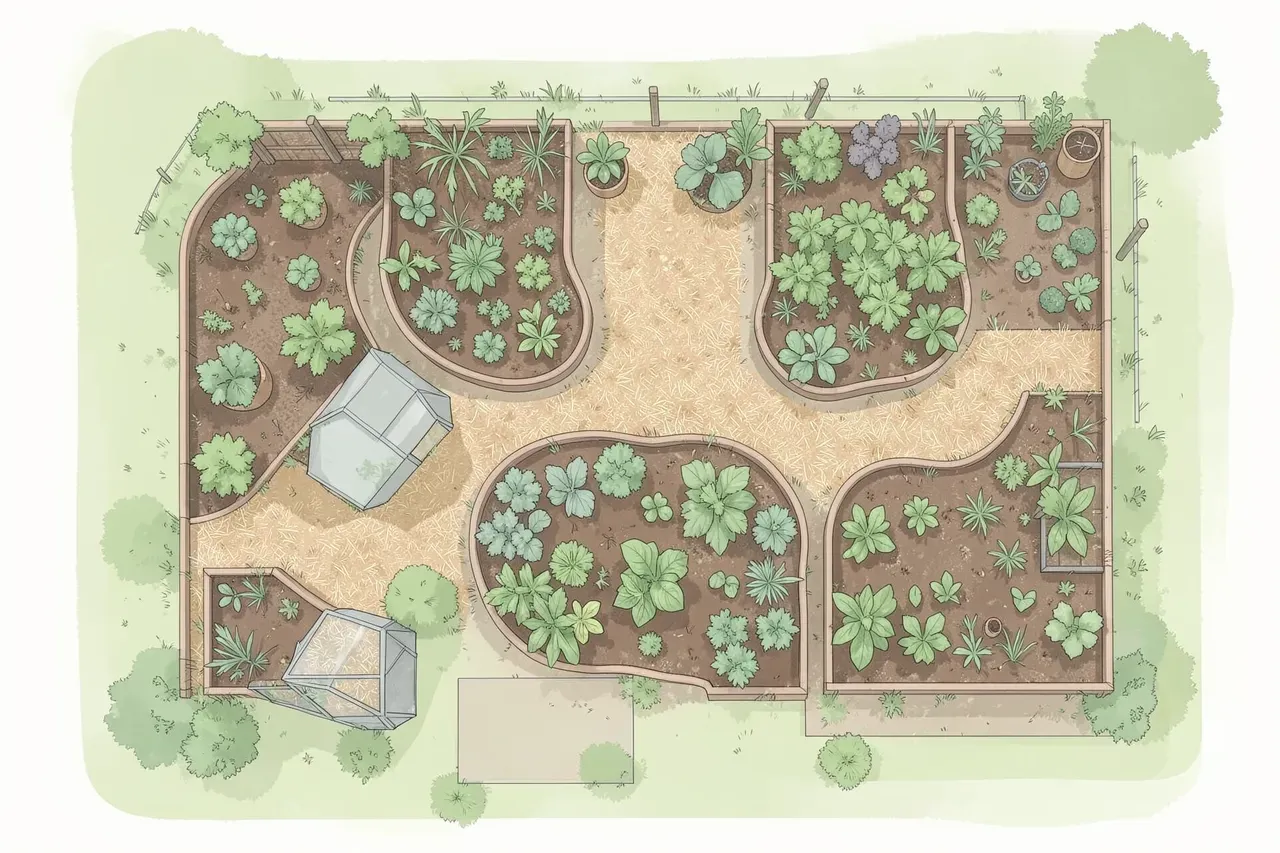
Once these elements are laid out, a question is already nagging at you: “and what does this look like for me?” Here are three sized templates, from the mini-garden to the nearly self-sufficient vegetable garden.
Three sized templates
Which template should you aim for? The specialized literature offers three, with figures. The minimal individual vegetable garden covers 30 to 50 kg/year per person. The family model fits on 50 m²: four beds of 1.2 × 5 m (24 m² cultivated), 12 m² of paths, 8 m² of herb borders, 3 m² of compost and rain barrel, with an optional 3 m² polytunnel greenhouse. Then there’s the nearly self-sufficient vegetable garden, about 100 m²: 8 beds of 1.2 × 6 m (60 m² cultivated), a potato and squash area, perennials such as asparagus and rhubarb, a 2 m² nursery.
On 50 m², the following layout balances yield and rotation:
| Crop type | Area | Role |
|---|---|---|
| Fruiting vegetables (tomatoes, squash…) | 20-25 m² | Volume and summer staple |
| Root vegetables | 10-12 m² | Winter storage |
| Leafy vegetables | 8-10 m² | Frequent harvests |
| Herbs and edible flowers | 3-5 m² | Pollinators and plant health |
No big plot? No problem. The “standard” size for urban gardeners is a 1.20 × 2.40 m bed (2.88 m²): everything remains reachable without compacting the soil. Even 4 m² (2 × 2 m) is enough for six to ten vegetables, and a 5 m² balcony can become a productive mini-ecosystem. The rules barely change with area: covered soil, diversity, accessible beds.
The areas are set. But two questions remain hanging — the ones that separate a vegetable garden that lasts from one that wears itself out: who grows next to whom, and who follows whom.
Companion planting: what it’s really worth
Companion planting pairs crops so they protect one another: one fixes nitrogen, another repels aphids, a third attracts pollinators. The classic pairings of market-garden tradition fit in one table:
| Main crop | Good companions | To avoid |
|---|---|---|
| Tomato | Basil, marigold, lettuce | Fennel, cabbage |
| Carrot | Onion, leek, radish | Dill, mint |
| Cabbage | Celery, rosemary, thyme | Strawberry, tomato |
| Zucchini | Bush bean, nasturtium | Potato |
Also famous are the Native American “three sisters”: corn, climbing bean and squash. The corn serves as a trellis for the bean, which fixes nitrogen; the squash covers the soil with its large leaves. Scatter edible flowers everywhere — nasturtiums, marigolds — which limit insect attacks and feed pollination.
A point of honesty is needed here, because the subject carries its share of legends — and claiming otherwise would be lying to you, and you’d sense it. The benefit of the tomato-basil pairing may owe as much to culinary use and flowering diversity as to any real protection of the plants, as several specialized guides point out. Some interactions have partial scientific support — nitrogen fixation by legumes, the effect of tagetes against nematodes — but systematic experimental validation, pairing by pairing, remains limited. Let’s be frank: treat these pairings as approaches proven in practice, not as guaranteed mechanisms. To start out, stick to readable pairings: carrot + onion/leek, tomato + basil, and the three sisters if space and warmth cooperate.
Companion planting set. But one rule remains which, on its own, separates sustainable vegetable gardens from depleted ones: rotation. Neglect it once, and your tomato bed will bill you for it for four seasons.
Crop rotation over four years
The golden rule of the permaculture vegetable garden: never two years in a row the same botanical family on the same bed. Why does it matter so much? Because monoculture establishes specialized diseases and always pumps the same nutrients; rotation breaks that cycle. The reference scheme runs over four years:
| Year | Bed A | Bed B | Bed C | Bed D |
|---|---|---|---|---|
| Year 1 | Nightshades (tomato, pepper, eggplant) | Cucurbits (zucchini, cucumber) | Leaves (lettuce, cabbage, chard) | Roots (carrot, beet, radish) |
| Year 2 | Roots | Nightshades | Cucurbits | Leaves |
| Year 3 | Leaves | Roots | Nightshades | Cucurbits |
| Year 4 | Cucurbits | Leaves | Roots | Nightshades |
Number your beds and keep an annual chart — it’s probably the most cost-effective tool a gardener can own.
Cost: zero euros.
Complete the rotation with the logic of nutrient demand levels: after a heavy-feeding crop (tomato, squash), follow with a less demanding one (beans), then a root or a leaf. Where should legumes fit in, then? The sources diverge: second year in some guides, third in others, absent from the reference cycle in the rest. No clear consensus, and that’s just fine. What matters lies elsewhere: no family should return to the same spot before four years.
Your plan is complete: zones, dimensions, pairings, rotation. It lacks only one thing to become vegetables in your kitchen — the right timing.
The production calendar
A productive vegetable garden is all about timing. Here is the framework calendar for a temperate French climate, to be adjusted afterward to your micro-climate — no one ever gardens exactly like their neighbor.
Sowing and planting, month by month
| Vegetable | Sowing | Planting | Harvest |
|---|---|---|---|
| Radish | March to September | — | 4 to 6 weeks after sowing |
| Lettuce/salad greens | March to August | — | 6 to 10 weeks after sowing |
| Carrots | Feb.-March (spring), July (fall) | — | June then October-November |
| Onions, leeks | From late February | Spring | July to November |
| Peas, fava beans, spinach | Late winter (tolerate cold) | — | Spring |
| Tomatoes | March-April under cover (20 °C) | After the last frosts (mid-May) | July to October |
| Zucchini, squash | April under cover | Mid-May | June to October |
| Beans | May to July (direct) | — | July to September |
| Basil, nasturtiums | April-May | May | Until the first frosts |
| Strawberries | — | Fall | May to July the following year |
Three local adjustments change everything. Allow a 2 to 3 week later shift in the North, as much earlier in the South, 3 to 4 additional weeks in the mountains. Stagger sowings by two weeks to spread out harvests and buffer setbacks. And beware of frost.
One single night. That’s all it takes to destroy tomato plants set out too early. Check the local history of last frosts and keep a safety margin — better a tomato planted late than a tomato scorched.
Field reports point the same way. A specialized growing journal recounts an indoor sowing of “Cœur de Bœuf” tomatoes on March 15, 2025, with germination in 5 days at 20 °C and planting on April 20, 2025 — an isolated observation, admittedly, but it clearly illustrates the time gain of sowing under cover. Adjust your calendar every year to the realities of the garden: squash sown too early in a cold spring? Push it back two weeks next year, full stop.
What you harvest, season after season
Spring brings the first salad greens, radishes, spinach and peas, while tomatoes and zucchini wait for the end of the frosts. Summer concentrates production: tomatoes from July to October, zucchini, beans, basil — “heatwave” mulching mandatory and an eye on water. Fall brings back the carrots sown in July (October-November harvest), storage squashes, fruit tree plantings and cartloads of fallen leaves. Winter, finally, is a season of design and protection rather than zero harvest: lamb’s lettuce, arugula and spinach sown in summer hold the ground.
To estimate your production, here are indicative yields per vegetable — editorial data from specialized sources, to be taken as orders of magnitude, not guarantees:
| Vegetable | Indicative yield |
|---|---|
| Tomatoes | 10-15 kg/m² |
| Carrots | 8-10 kg/m² |
| Potatoes | ≈ 4.5 kg/m² |
| Mesclun mix | 2-4 kg/m² |
| Shallots | ≈ 1.9 kg/m² |
Extending the season with protection: 4 to 6 weeks gained
Without protection, the season stops between October and November and only restarts in May. Six fallow months out of twelve — imagine everything your land could produce during that time. The greenhouse changes that equation. Backed against a south-facing wall, it creates a frost-free or nearly frost-free zone; you sow a month earlier — tomatoes sown under cover in March gain 4 to 6 weeks on the harvest — and you harvest later into autumn. A well-exposed wall already plays this “natural greenhouse” role for cold-sensitive crops. All that remains is to size this famous shelter, then make it pay for itself.
Integrating a greenhouse into your vegetable garden
The greenhouse, the productive heart of zone 1
In the zoning logic, the greenhouse goes in zone 1: due south, a stone’s throw from the house. Even a modest one stacks functions — the permaculture principle par excellence. Nursery first (all your spring seedlings, immediate savings on purchased transplants), then starting chamber for the cold-sensitive crops (tomatoes, basil, zucchini), season extender at both ends of the calendar, and finally winter production area for salad greens and microgreens.
In the 50 m² family template, specialized plans judge a 3 m² polytunnel greenhouse “optional but very useful”; in the larger 100 m² model, the nursery takes up 2 dedicated m². Square meters that keep working while the open-ground beds sleep.
You still need to know what to grow in it: soil… or not only.
Greenhouse and hydroponics: a more logical pairing than it seems
The question deserves to be asked frankly: hydroponics grows without soil, permaculture makes living soil its foundation. Incompatible? Not necessarily — provided you think in terms of complementarity. Closed-loop hydroponics consumes a fraction of the water of conventional watering, which directly serves the principles “catch and store energy” and “produce no waste”: the nutrient solution collected under the trays returns to the reservoir, and routine maintenance comes down to monitoring pH and electrical conductivity. It then concentrates intensive production on a very small footprint and frees up the rest of the garden for soil, biodiversity and storage crops. Finally, it excels where open beds are weak: winter production, microgreens, fresh herbs, fast plant starts.
The winning split seems clear: living soil remains the heart of the open-ground vegetable garden, and the hydroponic greenhouse becomes the intensive engine of zone 1 — the plant and off-season vegetable factory.
One caveat, though — and you saw it coming. A hydroponic loop depends on electricity and purchased specific fertilizers, which keeps it at a distance from the total self-sufficiency the discipline preaches. Weigh it against your priorities: continuous productivity on one side, complete self-reliance on the other.
All that’s left is the awkward question: what do 22 m² under cover actually yield? Here’s the math, assumptions stated.
What a 22 m² greenhouse really produces
How much does a 22 m² greenhouse actually add to your annual production? Let’s run the numbers with stated assumptions: 22 m² gross, i.e., about 17 m² of usable cultivated area once paths are deducted.
| Cycle | Crop | Area | Yield used | Estimated production |
|---|---|---|---|---|
| March-October | Staked tomatoes | 10 m² | 10-15 kg/m² (sourced figure) | 100-150 kg |
| March-October | Staked cucumbers or squash | 4 m² | 8-10 kg/m² (estimate) | 32-40 kg |
| October-February | Mesclun, spinach, arugula | 8 m² | 2-4 kg/m² × 1.5 to 2 successions | 25-60 kg |
| Year-round | Transplants, herbs, basil | Variable | — | Indirect value (transplants avoided) |
Total: roughly 160 to 250 kg/year under conventional management. Under intensive management — three successions per year, high trellising, drip fertigation, near-zero losses thanks to protection — protected-cropping practitioners aim for double, i.e., 400 to 500 kg/year.
Let’s be precise about the nature of these figures, because your trust must be earned: they are working assumptions built from the per-m² yields cited above, not data measured on a real installation. The result will depend on climate, your diligence and the choice of crops. But even at the bottom of the range, 160 extra kilograms from 22 m², out of season and pesticide-free, is a game-changer for a household’s self-sufficiency.
You now know what the greenhouse produces. All that’s left is the question everyone asks: how much does it cost — and above all, how much does it return.
Budget and profitability of a permaculture vegetable garden
What it costs to get started: €100 to €1,100 depending on your strategy
The entry ticket remains modest compared with equivalent hobbies — a bicycle costs more, and it doesn’t produce ratatouille. Detailed ranges from the specialized literature, phase by phase:
| Item | Range |
|---|---|
| Observation and design (notebook, stakes, string) | €0-50 |
| No-dig preparation (compost, cardboard, straw) | €0-200 depending on purchase or recovery |
| Infrastructure (rain barrel, drip irrigation, compost bin, trellis) | €50-400 |
| Perennials and fruit trees | €30-300 |
| Annuals: seeds, transplants, potting soil | €20-150 |
| Total startup cost | ≈ €100 to €1,100 (sum of the ranges, excluding land and tools already owned) |
For a small 20 m² vegetable garden, another source estimates startup between €50 and €150. The first hurdle, moreover, isn’t money but installation time.
On the greenhouse side, market prices vary widely by range (indicative ranges, to be checked with suppliers): a PVC tunnel or a cold frame costs about €50 to €300; a 5 to 10 m² polycarbonate greenhouse, €400 to €1,500; a structured 20 to 25 m² greenhouse, €2,500 to €7,000 depending on materials and glazing; hydroponic equipment adds to these amounts. The most cost-effective strategy remains the practitioners’: setting up a local supply chain for fallen leaves and wood chips with the neighborhood slashes the organic matter bill — bagged compost is the beginner’s costly trap.
The annual savings, calculated: up to €1,200/year on 50 m²
The formula fits on one line: annual value produced = yield in kg × avoided purchase price per kg. Take the well-managed 50 m² family garden: 200 to 400 kg/year according to specialized plans (figure from a single source, to be treated as an order of magnitude). With an avoided purchase price of €3/kg — an illustrative assumption, to be consolidated with your own receipts, since neither INSEE nor FranceAgriMer appears in the available sources for this calculation — the value produced reaches €600 to €1,200/year.
€600 to €1,200. Every year.
Add a 22 m² greenhouse producing an extra 160 to 500 kg, and the savings climb by another €480 to €1,500/year. On top of that come gains rarely counted: self-produced transplants, saved seeds, free rainwater, compost made from the household’s green waste.
The payback period: from a few months to 6 years
Return on investment is calculated: ROI = (annual value produced − recurring costs) / initial investment. Three scenarios:
| Scenario | Investment | Annual value | Estimated payback |
|---|---|---|---|
| 50 m² vegetable garden (all-recovered materials) | ≈ €100 | €600-1,200 | A few months |
| 50 m² vegetable garden (all-purchased) | ≈ €1,100 | €600-1,200 | 1 to 2 years |
| 22 m² greenhouse (mid-range, €3,500) | ≈ €3,500 | €480-1,500 | 2.5 to 6 years |
Six years, at worst. Here again, these are method demonstrations, not empty promises: recurring costs (seeds, water, maintenance) are not precisely quantified in the available sources. To gauge the professional order of magnitude, the INRA-AgroParisTech study of Bec Hellouin demonstrated the economic viability of permaculture market gardening on 1,000 m² — not a fast track to riches, the study is careful to note, but a minimum wage within reach while regenerating the soil.
Which, incidentally, changes the very definition of the word profitability.
The figures are on the table. All that remain are the questions you’re already asking yourself — the ones everyone asks before picking up the spade.
FAQ — Your questions about the permaculture vegetable garden
How much space do you need for a permaculture vegetable garden?
Start small: 4 m² is enough for six to ten vegetables, and 15 to 20 m², well designed, already produce surprisingly well. For food self-sufficiency, estimates diverge significantly: 200 m² per person (about 500 m² for a family of four) in one source, about 1,500 m² for 350 kg/year in the other — an unresolved disagreement, which reflects the influence of climate, soil and skill level. The right starting point remains the 50 m² family model, which would cover 50 to 70% of the vegetable needs of a family of four.
Do you need a building permit for a permaculture vegetable garden?
An open-ground vegetable garden requires no planning permission. For a greenhouse, under article R.421-2 of the French planning code, greenhouses used for domestic cultivation whose height does not exceed 4 meters are exempt from building permits; a prior declaration may still be required in certain protected areas ( surroundings of historic monuments, listed sites) or under the local PLU. These elements fall under general regulations: always check with your town hall before installation.
Does a permaculture vegetable garden produce in winter?
Yes, but differently: winter is a season of preparation and protection more than harvest. From September to October, you build lasagna beds, mulch empty beds and sow green manures (mustard, phacelia, clover) that will cover the soil. From November to February: compost, pruning fruit trees, selecting seeds, planning rotations. Winter harvests remain possible — lamb’s lettuce, arugula, spinach — especially under a greenhouse or cold frame.
How many kilograms of vegetables per year can you harvest?
The available benchmarks, to be taken as orders of magnitude: about 1.5 kg/m²/year for a classic hobby garden, 100 to 150 kg/year on 50 m² with careful permaculture design, 200 to 400 kg/year on 50 m² according to specialized plans, and 600 kg to a tonne on 100 m² well managed. An experienced amateur gardener featured in the specialized press even produces 300 kg/year on 50 m² without pesticides near Rouen — an anecdotal case, not an average. The gap between these figures illustrates the real variable: your method, not your area.
How much maintenance should you plan for a permaculture vegetable garden?
Count on 1 to 2 hours per week for a well-designed 50 m², about 30 minutes for 4 m², with peaks in spring (sowing, planting) and early autumn (green manures, mulching). The permaculture approach eliminates most chores: mulching blocks weeds, covered soil retains water, diversity limits recurring diseases. Tasks follow the seasons — compost and cold-season sowing at the end of winter, systematic mulching and staking in spring, water management and harvests in summer, fallen leaves and tree planting in autumn.
Permaculture beginner: what to plant first?
Go for forgiving crops: radishes (4 to 6 weeks), salad greens, bush beans, zucchini, peas and spinach at the end of winter. Add from the first season a simple companion pairing, carrot + onion, and an easy herb — basil, chives. Tomatoes will come from the second season under cover, once the frost calendar holds no more secrets for you.
Is composting mandatory in permaculture?
Composting is the engine of permaculture fertility, but it isn’t limited to the bin: mulching, green manures, fallen leaves and lasagna beds also compost, directly in place. A compost bin remains recommended for kitchen waste, positioned near the vegetable garden but sheltered from the wind. What matters is the flow — every organic residue from the household should return to the garden’s soil.
Move to production
6 key takeaways
Six points deserve to stay in mind. Observation first: sun, water, wind, soil (OPVT benchmark: 250 worms/m² for healthy soil) — it is the foundation of any successful permaculture garden. Next, the triad zoning, companion planting, rotation: daily crops near the door, beneficial pairings (tomato-basil, carrot-onion, three sisters), never the same botanical family two years running on a bed. Living soil at all times — no-till, systematic mulching, composting — in direct alignment with the NRCS/USDA soil health principles. A measurable economy: startup of €100 to €1,100, value produced of €600 to €1,200/year on 50 m², payback in under two years in most scenarios. Genuine scientific credibility, finally: economic viability validated by the INRA-AgroParisTech study of Bec Hellouin, productivity advantage measured at LER 1.44 by the RPTU and BOKU universities in 2024. And the greenhouse as a multiplier: 160 to 500 extra kilograms per year on 22 m².
Why the 22 m² hydroponic greenhouse is a game-changer
Every technique in this guide shares the same limitation: they remain subject to the climate. The greenhouse frees them from it. By combining the season extension of protected cropping and the water savings of a closed hydroponic loop, a 22 m² hydroponic greenhouse turns the vegetable garden into a continuous production system twelve months out of twelve — January sowings, early tomatoes, microgreens in mid-winter — while freeing up the open-ground beds for storage crops. It’s the permaculture logic pushed to its conclusion: each element (the soil, the greenhouse, the rainwater, the compost) performs several functions and serves the others.
The plan is in your hands. Observe your land this weekend, lay out your first no-dig beds this month, schedule your sowings on the next calendar. Each step has its own dedicated guide: detailed companion plantings, the complete guide to mulching, getting compost right in the garden and crop rotation explained. And when the time comes to move to year-round production, see how our 22 m² hydroponic greenhouse fits into a permaculture garden — dimensions, equipment and support included.
In a year, two futures await you. The first: a table where half the vegetables come from your beds, a grocery bill that shrinks, soil that improves on its own. The second: the same July as before — scorched tomatoes, wasted water, a spade rusting in the shed. The only difference between the two fits in a notebook and one weekend of observation. The choice is yours.
Main sources
- INRA / AgroParisTech study (2011-2015), “Organic market gardening on a small surface” — Kevin Morel, Sarah Guégan, François Léger, Bec Hellouin farm; detailed values by scenario available via inrae.fr.
- University study RPTU Kaiserslautern-Landau / BOKU Vienna (2024) — biodiversity, soil quality, carbon storage and yield (LER 1.44) in permaculture systems.
- USDA / NRCS — Soil health principles: nrcs.usda.gov.
- OPVT (Observatoire Participatif des Vers de Terre) — earthworm abundance benchmarks.
- French planning code, article R.421-2 — rules for domestic cultivation greenhouses.
- Practical data (calendars, yields, budgets) from French specialized guides (monjardinmonpotager.fr, annuaire-permacole.fr, habitats-durables.org, jardin-d-saveurs.com, ooba.fr, chezserge.fr, bobstools.net); figures from a single source are flagged as orders of magnitude in the text.
Ready to Grow Your Own Vegetables All Year Round?
Discover our soil-less growing solutions, aeroponic greenhouse or indoor hydroponic cabinet, and take the path to food self-sufficiency without pesticides.